
Rotator cuff tears
Rotator cuff tears also occur in people without pain, so a scan alone doesn’t tell the whole story. Even with a tear, Royal Pain can assess whether treatment could help you reach and lift with less pain.
Shoulder pain Physical Therapy in Chapel Hill
Stretching and rest haven’t solved your shoulder pain—and you don’t want to rely on pain relievers. Let’s look for what may have been missed.
“can scratch my back now as my mobility improved.”
— Srikant Jindam
Individual experience; results vary.
Make sense of what you’ve been told.
Rotator cuff tears also occur in people without pain, so a scan alone doesn’t tell the whole story. Even with a tear, Royal Pain can assess whether treatment could help you reach and lift with less pain.
Arthritis can cause pain and stiffness. At Royal Pain, we assess your movement and treatment response to explore what could help you reach, dress, and sleep with less pain.
A tear in the cartilage around your shoulder socket doesn’t automatically mean surgery. Royal Pain considers your pain, movement, and stability to assess whether our approach could help you return to daily activities.
These shoulder problems can make reaching or lifting painful, but the label doesn’t determine how much you could improve. Royal Pain tests your response to treatment to see what may help you move more comfortably.
A prospective study followed people with rotator cuff tears that were initially painless. Some developed pain and others remained symptom-free—showing that the presence of a tear alone doesn’t tell the whole story. Source
Dr. Derek Nielsen, PT, DPT starts with the movement that hurts, examines what may be contributing, then checks whether treatment changes that same movement.
At Royal Pain, we examine the movement that hurts and use a hands-on assessment to look for what may be contributing to your pain.
We treat what we believe is contributing, then repeat the painful movement to check whether your symptoms improve. Your response guides what we do next.
We use what helps to guide your treatment and show you what to do at home—so you can build on the relief and address what’s contributing to your pain.
Start with a conversation. Tell Dr. Nielsen what hurts and what you’ve tried. He’ll explain what he would assess first and recommend a next step.
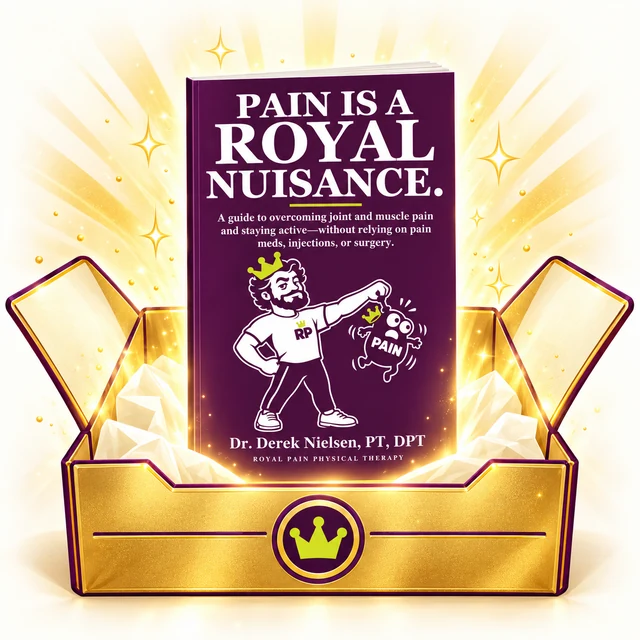
Start with a free copy of Pain Is a Royal Nuisance. Explore a process for working toward pain relief without medication or surgery—even if you’ve been told you have shoulder pain or a rotator cuff problem.
Dr. Derek Nielsen, PT, DPT examines your shoulder, neck, and upper back—even if only your shoulder hurts. He checks the movement that bothers you, treats what may be contributing, then repeats it. Improvement gives us evidence to guide the next step.
Not automatically. Some people have tears without pain; others need medical or surgical care. Royal Pain assesses your strength, movement, and treatment response to explore whether our approach could help. A recent injury with new marked weakness needs prompt assessment.
An assessment helps determine whether our approach could help you reach, lift, and sleep with less pain. Your diagnosis is part of that decision, alongside your symptoms and treatment response. Start with a call about what you’ve tried and the options you’re considering.
Dr. Derek Nielsen, PT, DPT assesses what may be contributing to your pain and provides treatment during your first visit. You’ll leave with:
You’ll discuss your shoulder pain, what makes it better or worse, and what you’ve tried. Dr. Derek Nielsen, PT, DPT will explain what he would assess first and recommend a next step—including whether an in-person assessment at Royal Pain makes sense.
Seek emergency care for shoulder or arm pain with chest pressure, shortness of breath, or sweating. Get prompt medical assessment after an injury if the shoulder has changed shape, you cannot lift the arm, or you develop sudden marked weakness, persistent numbness, or a hot swollen joint with fever.
Talk with Dr. Nielsen about your symptoms, what you’ve tried, and where he would start to help you move forward.
Governors Village · 50101 Governors Drive, Suite 280
Chapel Hill, NC 27517 · Get directions